Acknowledgements
This survey was funded by the National Parks and Wildlife Service, Biodiversity Recorders
Grant.
Nature Network Ireland would like to thank the National Parks and Wildlife Service for the
opportunity to run this survey. Thank you also to John Deasey, Emily Mangan, Sean Bourke,
Karl Woods and Melanie Mangan for their support and assisting with the surveys.
To Macdara O’ Shea and Gill Weyman of Nature Network Ireland for their help in developing the outline of the work and overseeing the project.
Introduction
The status of Irish moths of the family Sesiidae (Clearwings) is poorly known. Although the
Irish Clearwing species have been known since the 19th Century, there is very little recent information on their occurrence or habits. The moths fly by day, so are not attracted to light-traps (the method by which the vast majority of Irish moth records are now obtained); most of them are small, and some are probably overlooked as small flies in flight. As a result, they are almost certainly overlooked in many areas. The objective of the project is to increase our information on the species, primarily by using the current method of employing pheromone lures.
Current knowledge of the Irish Clearing species treated in this survey
Five species of the family Sesiidae are currently recognised as occurring in Ireland, viz.
- Sesia bembeciformis (Hubner, 1779) LUNAR HORNET MOTH
- Pyropteron muscaeformis (Esper, [1783]) THRIFT CLEARWING)
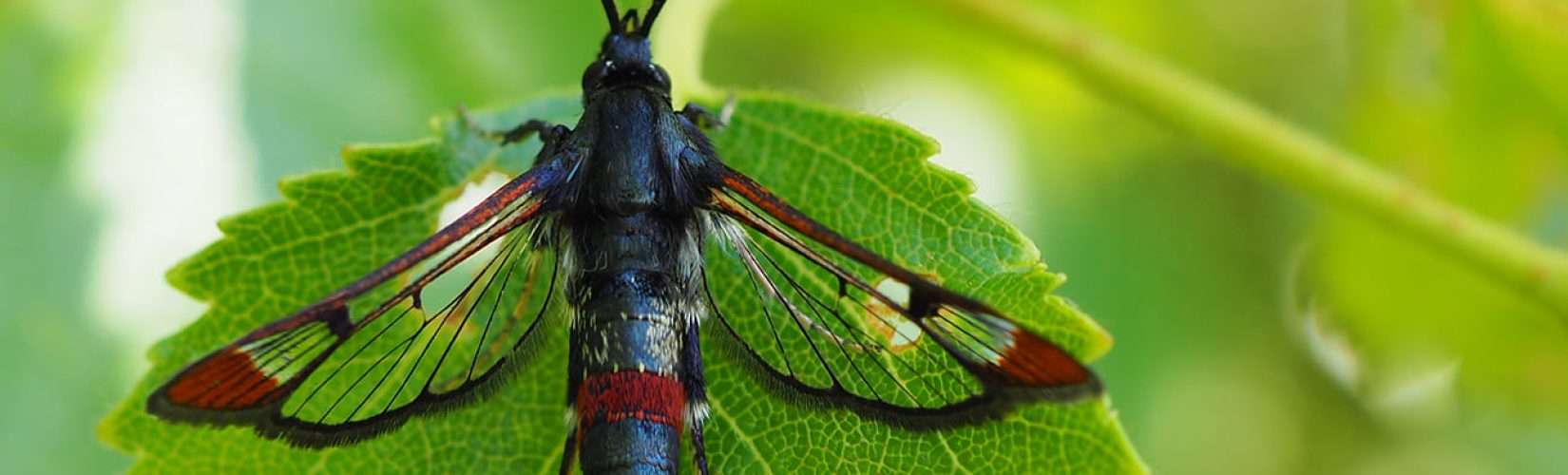
- Synanthedon formicaeformis (ESPER, 1783) RED-TIPPED CLEARWING
- Syanthedon tipuliformis (Clerck, 1759) CURRANT CLEARWING
- Pyropteron muscaeformis (Esper, [1783]) THRIFT CLEARWING)
The Lunar Hornet Moth is widely recorded in Ireland, at least in the North and East, and was
therefore excluded from this survey.
Literature records and more recent reports of the four Clearwing species covered in this
report.
Welsh Clearwing Synanthedon scoliaeformis (Borkhausen, 1789).
“Cronmaglaun Glen, Killarney, is the locality where Mr.Birchall found birch trees infested, he believed, with the species, but he did not get the imago. I also noticed similar traces in the same neighbourhood in 1885, but saw no imagines” (Kane, 1901).
“Rare and very local. Restricted as at present known to Killarney and Kenmare, Kerry. Birchall and Kane found the larvae infected birches here, and subsequently Kane took three specimens at the former place” (Donovan, 1936).
“Freshly-emerged imagos may be found on the trunks of these [old birch] trees in the early morning during July. Examples taken by me, 11/17.vii47, are considerably larger than Scottish (Rannoch) specimens taken some 50 years ago” (Baynes, 1964). The NBDC map for this species includes records from the Glencar area, Co. Kerry.
During the summer of 2021 Welsh Clearwing was found at a pheromone lure at Coolea, West Cork (Colin Hamilton, pers. comm., Sept. 2021).
Red-tipped Clearwing Synanthedon formicaeformis (Esper, [1783]). Not mentioned in Kane(1901) “Sesia formicaeformis was inserted by Birchall in his ‘Catalogue of the Lepidoptera of Ireland,’ with the note – ‘Mr. Halliday. – No information as to locality.’ It is not surprising that Mr. Kane refused the species a place in his recent list. But it must now be acknowledged as a genuine member of our fauna, as Col. J. W. Yerbury, who has been collecting in the past summer in the South-west of Ireland, took two males at Glengarriff on June 13th. By his generosity they are now in the Dublin Museum” (Carpenter, 1902).
“Quite recently I received from Mr. L. W. Newman, of Bexley, an example of Sesia formicaeformis, bred July, 1920, from Co. Kerry; this is an addition to the list of our native Lepidoptera” (Greer, 1920).
“In my notes in the Irish Naturalist of December, 1920, I stated that this insect was new to the Irish list of Lepidoptera; this is an error, as I quite overlooked the capture of two examples by Col. J. W. Yerbury at Glengarriff in June, 1921, and recorded by Prof. Carpenter in this magazine for January. 1902. My specimen is from the Kenmare district, where Mr. A. E. L. Sabine found the larvae not uncommonly in stems of sallows growing in exposed situations. No doubt it has a wide range in the South of Ireland” (Greer, 1921).
“Scarce. Very Local….. Kerry: Near Keamare, larvae and pupae found in sallow stems and twigs, chiefly in wild exposed places where sallows are stunted. Fine series bred (L.A.E. Sabine, in list., 22/11/20.)”(Donovan, 1936).
The Red-tipped Clearwing Synanthedon formicaeformis (Esper, [1783]).
Not mentioned in Kane (1901). “Scarce. Very local. Near Kenmare, larvae and pupae found in sallow stems and twigs, chiefly in wild exposed places where sallows are stunted. Fine series bred (L.A.E. Sabine, in litt., 22/11/20.) Also near Kenmare, imagos bred from sallow twigs (Greer). Cork: Glengariff, two males. Captured by Colonel J. W. Yerbury and are in the Dublin museum(Carpenter, Irish Nat., 1902, p.19)”(Donovan, 1936). The following manuscript entry has been added to Donovan’s account: “LOUTH.E. of Essexford 1.7.1943 2 app. Stelfox.I.N.J.VIII.p.3080”.
“Mr. H. C. Huggins” has specimens labelled L. W. Newman, Sligo, 1920 and he himself obtained larval workings in sallow in the Coomarkane Valley, near Glengarriff.
The species seems to be not uncommon in this area, where the author found larval workings and bred the moth from near the town of Glengarriff, iv.53, from the Coomhola Valley, iv.54, and from Gougan Barra, vi.53″ (Baynes, 1964). Also recorded from a few well separated localities in Ireland” (Baker, 1985). The distribution map in Baker (loc. cit.) indicates its occurrence in Co. Sligo. The NBDC distribution map shows several widely distributed locations from Sligo southwards to Tramore, Co. Waterford (https://maps.biodiversityireland.ie/ Map/Terrestrial /Species/78625).
Currant Clearwing – Synanthedon tipuliformis (Clerck, 1759). Kane (1901) writes “Common” near Dublin, and elsewhere found in Ireland [Derry Campbell]. Donovan (1936) repeats Kane’s remarks and has “Rare”. “At present recorded from two counties only as common near Dublin (Birchall and Kane); Dublin district, not common (Westropp): Lucan (Dunlop)”. “Subsequently, a specimen was recorded from his [Donovan’s] sister’s garden, Ummera, Timoleague, Co. Cork, 18.vi.42. Mr. Dudley Westropp used to find it fairly frequently in his garden at Clonskeagh, Dublin. The moth has also been recorded rom Rathgar (A. W. Stelfox), Rathmines (A. M. Gwynn), and Seapoint, Co. Dublin (B. P. Beirne), (Baynes, 1964).
“Scattered records from Ireland”; occurrence in North Kerry and West Cork indicated on distribution map (Baker, 1985). The National Biodiversity Data Centre (NBDC) map for this species indicates three other recent records of this species: from Ennis, Co. Clare, Carrick-on- Suir, Co. Waterford; and at two sites near Cork City (https://maps biodiversity ireland ie/Species/78619.
Thrift Clearwing – Pyropteron muscaeformis (Esper, [1783]).
“M.r Gregson is said it have taken a specimen at Howth. I found it on the Saltee Islands, Co. Wexford, where, however, it was scarce” (Kane, 1901).
“I should say widely spread and common al along the Irish coast, although the records at present available notify tt Howth Co. Dublin (Gregson and Westropp); Saltee Island (Kane); Coast near Ferns, Co. Wexford (Greene). I have met with it, especially as larvae in Sea Thrift, from Cork Harbour, westwards all along the south coast it the Dingle peninsula, Kerry; also in Co. Clare, near Blackhead, and Langham reports two imagines from the cliffs of Moher in the same county. This little Clearwing flies in numbers, when the sun si out, among rocks where the Thrift grows; some settle on the flowers of the plant, a few are obtained in copula thereon. In about half a mile of coast near Courtmasherry, Co. Cork, I found eighteen pupae on 10* June, 1901, and seven dozen two days later, in dead plants of America.
In the box wherein these pupae were kept, it was observed that the newly emerged imagines hid among the cocoon-containing portions of Thrift and jumped and skipped about when the tufts were removed” (Donovan, 1936).
“The only recent record is Zetland Cove, near Glengarriff, Co. Cork, very local and scarce” (Baynes, 1964). “Southern Ireland” (Baker, 1985). The NBDC map for this species shows recent records from only The Burren, Co. Clare, and Cape Clear Island, West Cork (Bond) (https://maps.biodiversity ireland.ie/Map/Terrestrial/Species/80523.
The historical literature also contains Irish records of the following three Sesiidae. The first of these, Sesia apiformis, is currently considered extinct in Ireland, while there is considered it be insufficient evidence it accept the Irish occurrence of the other two:
- Sesia apiformis (Clerk, 1759) HoRNET MoTH
- Synanthedon culiciformis (Linnaeus, 1758) LARGE RED-BELTED CLEARWING
- Synanthedon myopiformis (Borkhausen, 1789) RED-BELTED CLEARWING
Methodology
During June, July and August in 2021, visits were made to potential sites in West Cork, South Cork, Cork City and North Cork to place lures at sites on plants such as Current/Gooseberry bushes, Sallow, Birch or Sea Thrift. In recent years the use of pheromone lures has been found to be highly successful in attracting the males of target moth species. The application of lures has largely been aimed at recording and assessing the abundance of pest species, but it has also included the targeting of little-known or rare species, especially those which are unlikely it be found at light-traps. This has greatly expanded our knowledge of the abundance and distribution of such species. Pheromone lures for the four species were ordered and obtained from Anglian Lepidopterist Supplies, and received early in June 2021. The lures, which consisted of rubber bungs impregnated with pheromone, were placed on twigs or branches on,
or very close to the relevant food plants, usually attached by a thread, but in the case of the Thrift Clearwing the following method was also applied: a lure was placed inside a sawn-off clear plastic bottle, to allow for the moth to be clearly observed, and if necessary caught for reference purposes.
Results
Table 1. Results of pheromone lure use by all surveyors
| Target Species | Date | Location | Grid Ref. | Results | Recorder |
| Red-tipped Clearwing | 14 June 2021 | Coolkellure | W158536 | nil | Ken Bond |
| Red-tipped Clearwing | 14 June 2021 | Manch Woodland | W310537 | nil | Ken Bond |
| Red-tipped Clearwing | 17 June 2021 | Tramore Valley Park | W684692 | nil | Ken Bond |
| Red-tipped Clearwing | 19 June 2021 | Glashaboy South | W625866 | nil | Ken Bond |
| Thrift Clearwing | 27 June 2021 | Lion’s Cove, Donaghmore | W459376 | nil | Ken Bond |
| Thrift Clearwing | 27 June 2021 | Leganagh Point, Seven Heads | W508356 | 3 specimens | Ken Bond |
| Thrift Clearwing | 27 June 2021 | Dunworley | W480370 | 1 specimen | Ken Bond |
| Welsh Clearwing | 29 June 2021 | Cappagh Wood, Killavullen | W647978 | nil | Ken Bond |
| Red-tipped Clearwing | 1 July 2021 | Kilcolman Fen | R583109 | nil | Ken Bond |
| Currant Clearwing | 3 July 2021 | Maryborough (Douglas) | W710692 | nil | Ken Bond |
| Thrift Clearwing | 4 July 2021 | Barry’s Head | W727499 | nil | Ken Bond |
| Currant Clearwing | 8 July 2021 | Ballymaloe House | W951679 | nil | Ken Bond |
| Thrift Clearwing | 14 July 2021 | Galley Head | W340318 | nil | Ken Bond |
| Currant Clearwing | 09/08/2021 | Killavullen | W645993 | nil | Melanie Mangan |
| Currant Clearwing | 10/08/2021 | Killavullen | W645993 | nil | Melanie Managan |
| Thrift Clearwing | 03/08/2021 | Owenahincha | W300351 | nil | Melanie Managan |
| Red-tipped Clearwing | 03/08/2021 | Rosscarbery | W297353 | nil | Melanie Managan |
| Welsh Clearwing | 04/08/2021 | Glengarriff | V916566 | nil | Karl Woods |
| Welsh Clearwing | 04/08/2021 | Glengarriff | V908567 | nil | Karl Woods |
| Welsh Clearwing | 04/08/2021 | Glengarriff | V896568 | nil | Karl Woods |
| Welsh Clearwing | 04/08/2021 | Glengarriff | V907575 | nil | Karl Woods |
| Red-tipped Clearwing | 06/08/2021 | Inchybridge | W464457 | nil | Karl Woods |
| Thrift Clearwing | 07/08/2021 | Barry’s Head | W727500 | nil | Karl Woods |
Table 2. Locations of successful use of HYL pheromone by John Deasy for Thrift Clearwing
| Location | Grid Reference | Date | Time (BST) | Weather | Notes |
| South Ring, Clonakilty | W412382 | 29/06/2021 | 17:11 | Sunny, dry, warm | Bank/wall dominated by cushions of Thrift (Armeria maritima) on coastal path near headland |
| Galley Head Ardfield | W340318 | 30/06/2021 | 13:32 | Sunny, warm | Bank/wall dominated by cushions of Thrift near car park |
Table 3. Locations of unsuccessful use of HYL pheromone by John Deasy for Thrift Clearwing
| Location | Grid Reference | Date | Time (BST) | Weather | Notes |
| Long Strand, Castlefreke | W338334 | 30/06/2021 | 16:08 | Sunny, warm, dry | Bank/wall dominated by cushions of Thrift over low sedimentary cliff |
| Downeen Point, Rosscarbery | W298347 | 30/07/2021 | 12:27 | Mainly overcast occasional with sunny spells, warm dry | Rocky headland with scattered Thrift |
| Mizen Head Visitor Centre | V741235 | 11/07/2021 | 16:40 | Mainly overcast occasional with sunny spells, warm dry | Broken ground next to visitor centre with scattered Thrift |
Table 3. Locations of unsuccessful use of HYL pheromone by John Deasy for Thrift Clearwing
| Location | Grid Reference | Date | Time (BST) | Weather | Notes |
| Reacarrigeen, Ballinascarthy | W434460 | 17/07/2021 | 14:39 | Sunny, warm, dry | Freshwater marsh, willow scrub, wet grassland mosaic |
| Beal na Blath, Kilmurry | W409627 | 23/07/2021 | 16:50 | Sunny, warm, dry | Willow scrub next to stream adjacent to ambush site memorial. At least 3 individuals. |
| Reacarrigeen, Ballinascarthy | W434460 | 25/07/2021 | 14:00 | Sunny, warm, dry | Freshwater marsh, willow scrub, wet grassland mosaic. At least 3 individuals. Specimen collected for K. Bond on request. |
Table 4. Locations of successful use of FOR pheromone by John Deasy for Red-tipped Clearwing
| Location | Grid Reference | Date | Time (BST) | Weather | Notes |
| Murragh Bridge, Enniskeane | W381541 | 23/07/2021 | 17:03 | Sunny, warm, dry | Willows along riparian zone of Bandon River |
| Clogheen marsh, Clonakilty | W379386 | 24/07/2021 | 12:54 | Sunny, warm, dry | Willows along drain on southern side of Clogheen Marsh |
| Inchybridge, Timoleagus | W467457 | 18/07/2021 | 11:45 | Sunny, warm, dry, breezy | Willow scrub in marsh/wet grassland meadow downstream of bridge |
Conclusions and recommendations
The selective use of Pheromone lures produced mixed results, but included some very useful records, confirming that some of these species have been overlooked in recent years. In particular, the Thrift Clearwing moth has been shown to occur widely on parts of the Cork coast. Being now confirmed from these precise locations, the opportunity of searching for the larva in May, as described in Baker (1985) arises. The Red-tipped Clearwing has also been recorded at new sites, and this again provides an opportunity for searching for the larva and its workings in Spring, as illustrated by von Scholley-Pfab (2021). The results of the Currant Clearwing searches were disappointing, but this may be largely due to our lack of knowledge of the history of the survey sites, e.g. age of currant bushes, and whether they have been treated with insecticides. Although Welsh Clearwing was not recorded during this survey, a new site for this highly localised species was discovered independently in West Cork (see above). One aspect that probably received insufficient attention is the need for sunny conditions for Clearwing moth flight activity. Much of the sampling, at least up to mid-July, was carried out in cloudy conditions, or in shaded locations.