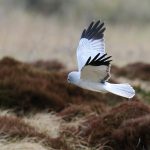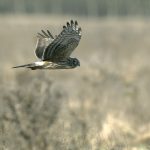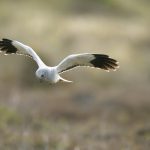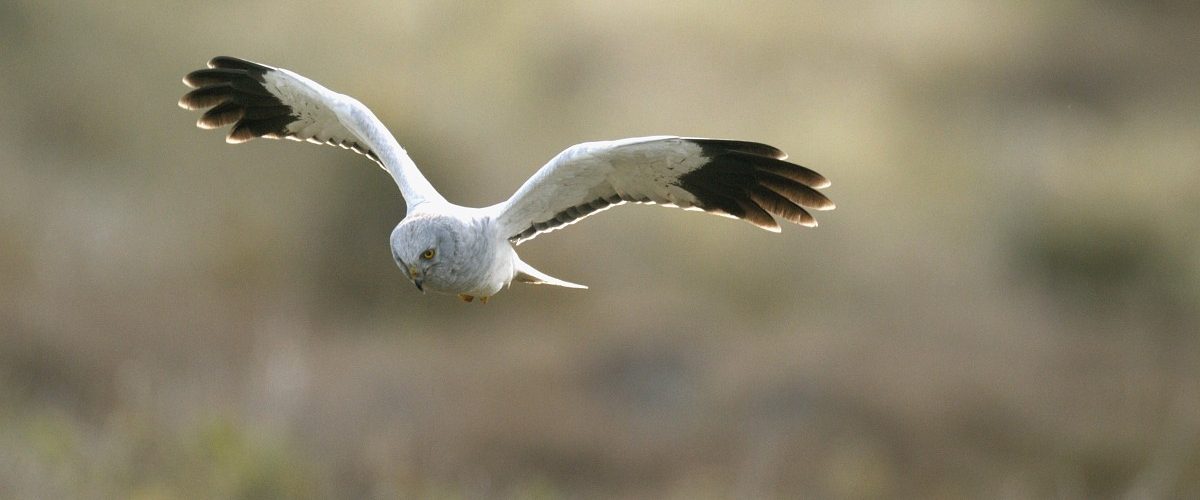
The Hen Harrier (Circus cyaneus) is Ireland rarest raptor but also its most spectacular. Known as Cromán na gCearc in Irish, these birds are protected in Ireland. Ireland is home to the most westerly population of these raptors with over 60% of the population being within the counties of Munster.
Females are larger than males. They are brown with long “ringed” tails and have a white rump. Males are a grey/silver colour, and they have black tips at the end of their wings. The young hen harriers are a similar brown colour to the females. This allows them to be camouflaged in their nests as they are ground nesters and therefore vulnerable to predators.
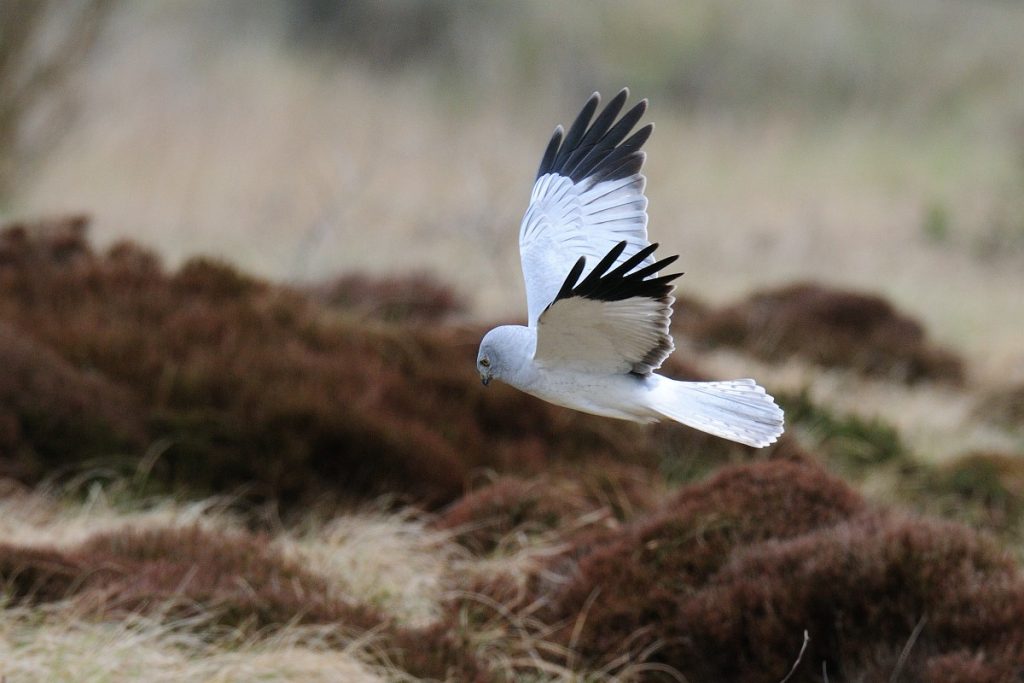
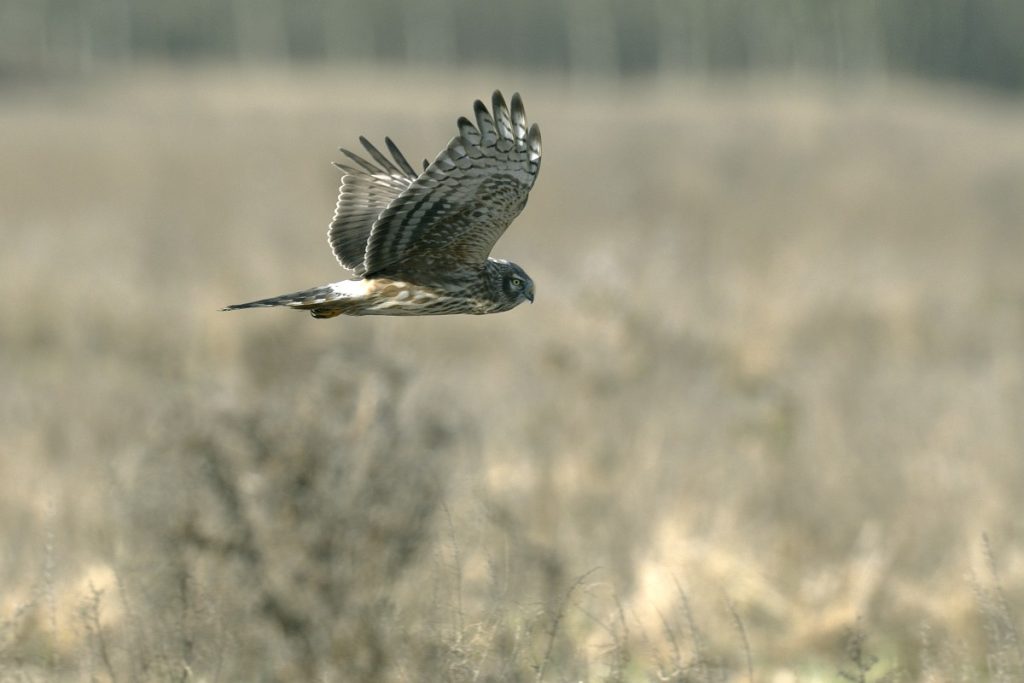
During March and April, in the breeding season, the males compete to try and win females attention by preforming a magnificent courtship display called the “SkyDance”. Males will show off by flying to spectacular heights and then suddenly will drop to the ground. As they fall to the ground they will twist and turn as well as call to the female they are trying to impress. As they are about the hit the ground, they will suddenly fly up again.
The hen harrier glides close to the ground when catching food. They feed on small birds such as meadow pipit Anthus pratensis and small mammals such as mice. When carrying out the “food pass” males will hold their food in their talons and pass it onto the female who is turned upside down!
These raptors are typically found in upland habitats during the summer and spring. They can be found in areas of low intensity farming, in young conifer plantations, in bogs and in moorlands. They particularly prefer areas where heather (Calluna spp.) is common as it provides a good breeding habitat for these ground nesters. In the winter, they can be found in the lowlands and possibly in coastal areas.
The hen harrier has an Annex I conservation status in Ireland as well as being amber listed. The hen harrier is listed on Annex I of the EU Birds Directive (amended 2009), which lists bird species that require special conservation measures concerning their habitat, and is an amber list species of medium conservation concern under the Birds of Conservation Concern in Ireland 2020-2026 assessment. This bird of prey was once widespread across Ireland but over the last few hundred years, their range and numbers have declined due to intense agriculture practices, habitat modifications and the maturation of conifer plantations. When the trees in plantations grow too big, the habitat on the ground level is lost and as a result, the hen harrier has nowhere to nest.
As these birds are of conservation concern in Ireland, there are six special protection areas (SPA) across the country. These areas span across the eight counties of Cork, Kerry, Limerick, Tipperary, Clare, Laois, Offaly and Monaghan. The habitats across the six SPA are those that are favoured by the hen harrier, so in theory they should be thriving in these areas. However, that is unfortunately not the case as their numbers continue to decline. The 2022 National Hen Harrier survey showed that these magnificent birds are under threat. Over the last seven years, since the previous survey was carried out, the numbers of these birds have decreased by one third and their breeding range has contracted by 27%. It is believed that there is only a maximum of 106 breeding pairs located across the country with only 85 confirmed pairs. In the 2015 survey, it was believed that there were 108-157 breeding pairs. Farmers across the six SPA are encouraged to take part in High Nature Value (HNV) Farmland. Farmers who take part in this carry out low intensity farming practices that promote high biodiversity and clean air, soil and water in the area.